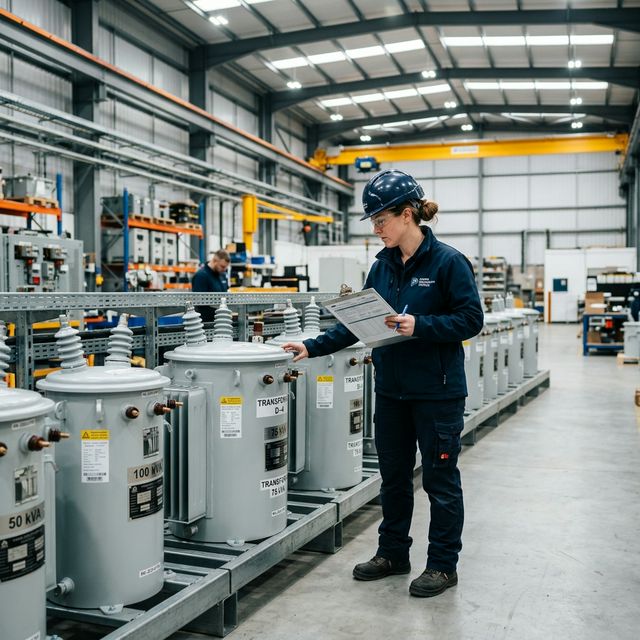
Selecting the right distribution transformer requires careful analysis of multiple technical and commercial factors. This guide walks you through the key decisions step by step.
Step 1: Determine Your Load Requirements
Before selecting a transformer, calculate your total connected load and expected demand:
- Connected Load: Sum of all equipment ratings in kW
- Demand Factor: Ratio of maximum demand to connected load (typically 0.6–0.8)
- Diversity Factor: Account for non-simultaneous operation of loads
- Growth Factor: Plan for 10-20% future load growth
Example: A commercial building with 800kW connected load, 0.7 demand factor, and 15% growth allowance:
Required capacity = 800 × 0.7 × 1.15 ÷ 0.85 (power factor) = 757 kVA → Select 800 kVA
Step 2: Choose Voltage Class
Match your transformer's primary and secondary voltages to the local grid:
| Region | Primary (HV) | Secondary (LV) |
|---|---|---|
| China | 10kV, 35kV | 400V, 690V |
| Europe | 11kV, 20kV, 33kV | 400V, 690V |
| Americas | 13.8kV, 34.5kV | 480V, 208V |
| Middle East | 11kV, 33kV | 400V, 415V |
Step 3: Select Transformer Type
Choose based on your installation environment:
- Oil-immersed → Outdoor, large capacity, utility networks
- Dry-type → Indoor, fire-sensitive, near human activity
- Amorphous core → High idle-time networks, energy efficiency mandates
Step 4: Specify Loss Level
Modern standards define energy efficiency tiers:
- IEC 60076-20: Defines Tier 1 and Tier 2 efficiency levels
- EU Ecodesign (548/2014): Mandatory minimum efficiency for EU market
- US DOE: 10 CFR 431 efficiency standards
Higher efficiency = higher purchase price, but lower lifecycle cost.
Step 5: Consider Environmental Conditions
- Altitude: Derate by 1% per 100m above 1000m
- Temperature: Adjust for average ambient exceeding 30°C
- Humidity: Specify tropical treatment for coastal/humid locations
- Seismic: Special mounting for earthquake-prone areas
- Corrosion: Specify C3/C4/C5 corrosion protection for coastal sites
Step 6: Define Accessories and Options
Common options to specify:
- On-load or off-circuit tap changer
- Temperature monitoring (oil/winding)
- Buchholz relay (oil-immersed)
- Pressure relief valve
- Marshalling box and cable termination
- Noise level requirements
Common Sizing Mistakes to Avoid
- Oversizing by too much — An oversized transformer runs at low load factor, wasting energy through higher no-load losses
- Ignoring harmonics — Non-linear loads (VFDs, UPS, LED drivers) increase losses; consider K-rated transformers
- Forgetting future loads — Under-sizing for growth leads to costly replacements
- Wrong cooling specification — ONAN rating is lower than ONAF; ensure you specify the correct cooling mode
Get Expert Help
VoltBridge's engineering team provides free technical consultations for transformer selection. Share your project details and we'll provide a recommended specification with budget pricing within 48 hours.