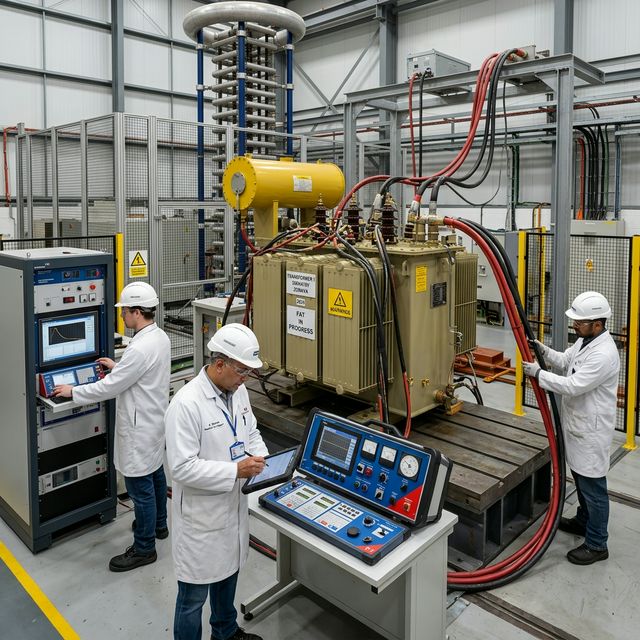
Factory Acceptance Testing (FAT) is the final quality gate before a transformer ships to a customer. These tests verify that every unit meets its design specifications and complies with applicable standards. Understanding FAT helps buyers ensure they receive a quality product.
Test Categories per IEC 60076-1
Routine Tests (Performed on Every Unit)
These tests are mandatory on every transformer produced:
- Winding Resistance Measurement
- Measures DC resistance of each winding at each tap position
- Detects bad joints, broken strands, or incorrect conductor size
- Results should match calculated values within ±0.5%
- Transformation Ratio and Vector Group
- Verifies voltage ratio at all tap positions
- Confirms vector group designation (e.g., Dyn11)
- Ratio tolerance: ±0.5% of declared ratio
- Short-Circuit Impedance and Load Loss
- Measures impedance voltage and load losses at rated current
- Impedance must meet ±10% of specified value
- Load loss must not exceed guaranteed value
- No-Load Loss and Current
- Measured at rated voltage with secondary open-circuited
- No-load loss must not exceed guaranteed value
- Corrected for waveform factor if necessary
- Dielectric Tests
- Applied voltage test: Tests insulation between windings and ground
- Induced voltage test: Tests inter-turn and inter-layer insulation
- Test voltages per IEC 60076-3
- Insulation Resistance
- Megger test to verify insulation integrity
- Minimum values depend on winding voltage class
Type Tests (Performed on Representative Units)
Type tests validate the design and are performed on the first unit of a new design:
- Temperature Rise Test
- Full-load thermal test running 8-12 hours
- Verifies oil temperature rise ≤ 55K (top oil)
- Verifies winding temperature rise ≤ 65K (average)
- Lightning Impulse Test
- 1.2/50 μs standard impulse waveform
- Usually 3 reduced + 3 full-wave impulses per terminal
- Verifies insulation withstands transient overvoltages
Special Tests (By Customer Request)
Available on request at additional cost:
- Noise level measurement (IEC 60076-10)
- Short-circuit withstand test (IEC 60076-5)
- Harmonic current response
- Zero-sequence impedance
- Chopped impulse test
- Partial discharge measurement
- Frequency response analysis (FRA) — baseline for future diagnostics
Customer Witness Testing
Buyers are always welcome to witness FAT at VoltBridge's testing facility:
- Tests conducted in our CNAS-accredited laboratory
- Independent test engineer available on request
- Third-party witness (SGS, BV, TÜV) can be arranged
- Complete test report issued within 48 hours of test completion
Understanding Test Reports
A good test report should include:
- ✅ Transformer nameplate data and specifications
- ✅ All routine test results with pass/fail criteria
- ✅ Test instrument calibration certificates
- ✅ Temperature and humidity at time of testing
- ✅ Waveform records for impulse tests
- ✅ Photographs of the finished transformer
Common Test Failures and Root Causes
| Failure | Possible Cause | VoltBridge Prevention |
|---|---|---|
| High no-load loss | Poor core steel quality or assembly | Incoming material testing, precise core cutting |
| High load loss | Conductor quality or winding geometry | Computer-optimized design, CNC winding |
| Failed dielectric test | Contamination or insulation defect | Clean room assembly, vacuum drying |
| High temperature rise | Inadequate cooling design | CFD simulation, prototype validation |
VoltBridge Quality Promise
Every VoltBridge transformer undergoes all routine tests in our CNAS-accredited laboratory. We maintain a first-pass test yield of >99.5%, reflecting our commitment to manufacturing quality. Test reports are available digitally within 48 hours of completion.